




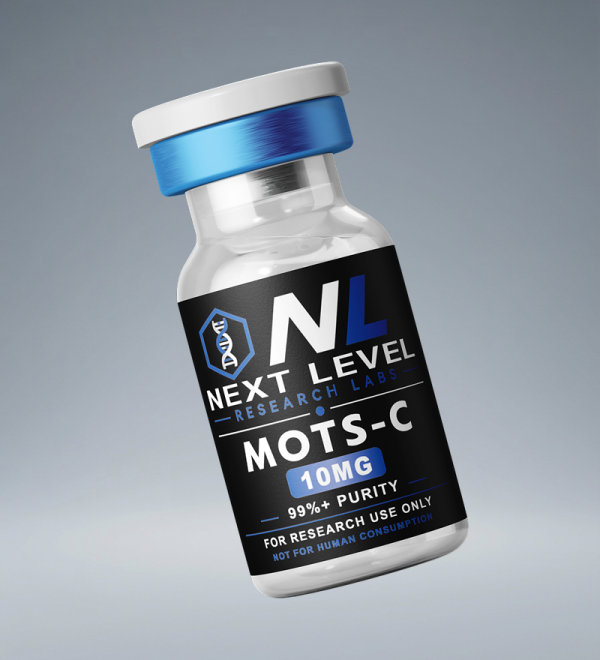
MOTS-C
Bundle & Save
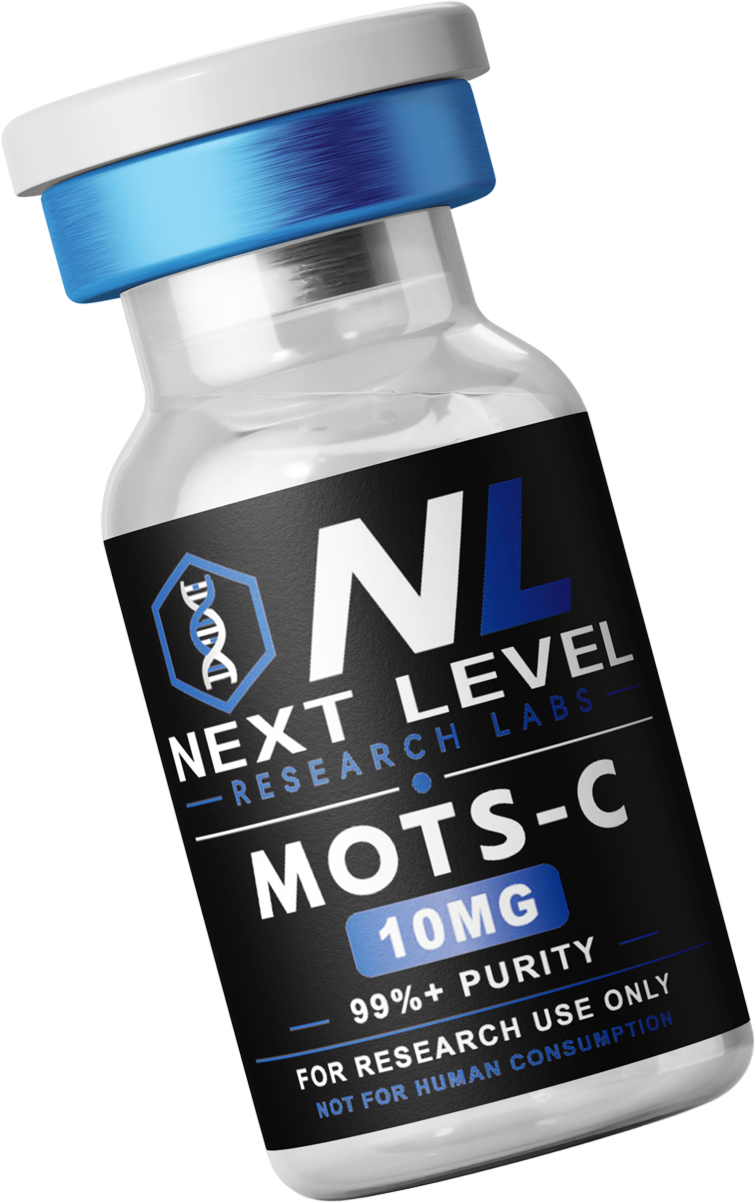
- All Products are supplied in lyophilized (powder) form
- Bacteriostatic Water (BAC Water) is sold separately.
- Intended exclusively for laboratory and in vitro research use.
 Description
MOTS-C is a mitochondrial-derived peptide research compound designed for laboratory investigation of cellular energy signaling and metabolic regulation pathways. MOTS-C is studied in preclinical research for its association with mitochondrial communication, AMP-activated protein kinase pathway modeling, glucose metabolism research, cellular stress-response signaling, and energy homeostasis models.
This compound is intended strictly for in vitro and preclinical laboratory research.
 Specifications
Product Classification: Research-Use-Only (RUO)
Total Content: 10 mg lyophilized powder per vial
Compound: MOTS-C peptide research compound
Form: Sterile lyophilized peptide compound
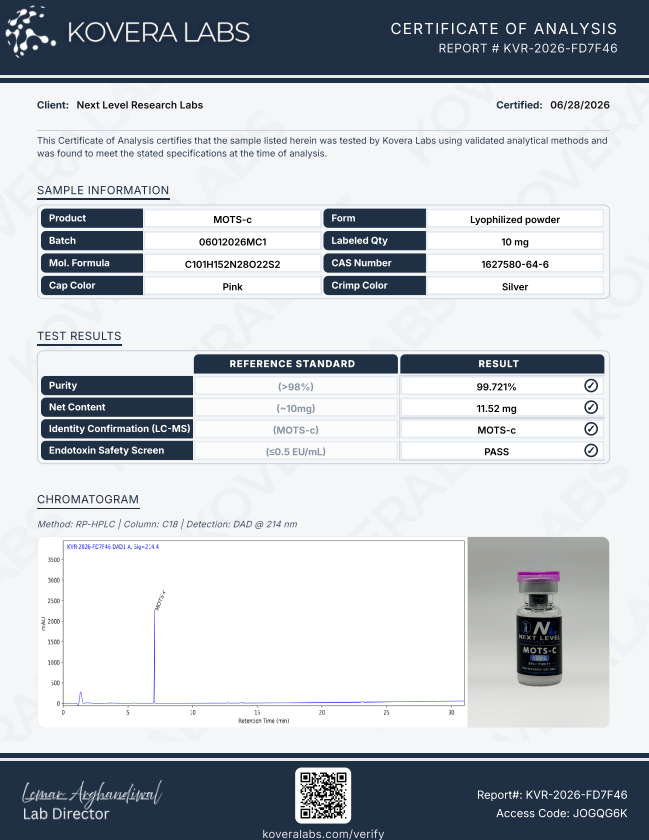
Purity: ≥99%
Storage: Store at −20 °C, protected from light
Packaging: Glass vial in protective sleeve
 Applications
Intended for preclinical laboratory research only, including:
• Mitochondrial signaling research
• Cellular energy metabolism studies
• AMPK pathway modeling
• Glucose metabolism experiments
• Cellular stress-response research
• Metabolic regulation models
• Longevity-associated pathway studies
 Warning
Not for human or animal use. For research purposes only.
 Scientific Report
Abstract
MOTS-C is a mitochondrial-derived peptide investigated for its role in cellular energy regulation and metabolic signaling. MOTS-C is designed for controlled laboratory studies examining mitochondrial communication, metabolic pathway response, glucose signaling, cellular stress adaptation, AMPK-associated pathway activity, and age-related cellular function models.
Mechanistic Pathway
MOTS-C is designed around mitochondrial and metabolic pathway modeling.
Mitochondrial Signaling Pathway
- Supports research into mitochondrial-derived peptide signaling
• Used in models of cellular energy regulation
• Studied for mitochondrial-to-nuclear communication pathways
Effect: Provides a model for mitochondrial signaling activity in controlled research systems.
AMPK-Associated Pathway
- Supports investigation of energy-sensing pathways
• Used in metabolic stress-response models
• Helps evaluate downstream cellular adaptation signaling
Effect: Enables research into energy-regulatory pathway activation.
Glucose Metabolism Pathway
- Supports research into glucose handling models
• Used in metabolic regulation experiments
• Relevant to cellular fuel-utilization pathway studies
Effect: Provides a model for studying glucose-related cellular signaling responses.
Pharmacokinetics / Research Profile
| Compound | Pathway | Research Notes |
| MOTS-C | Mitochondrial / AMPK-associated signaling | Mitochondrial-derived peptide model for metabolic and cellular energy research |
Dosing Models in Research
Used only in controlled in vitro and preclinical research models to study mitochondrial signaling and metabolic pathway response. No human or animal-use instructions are provided.
Preclinical Research Highlights
- Studied as a mitochondrial-derived peptide research model
• Used in cellular energy and metabolic regulation studies
• Supports research into AMPK-associated pathway signaling
• Relevant to glucose metabolism and cellular stress-response models
• Useful for longevity-associated pathway investigation
Conclusion
MOTS-C provides a research-use-only model for studying mitochondrial-derived peptide signaling and metabolic pathway regulation. Its research profile supports investigation into cellular energy balance, mitochondrial communication, glucose metabolism, AMPK-associated signaling, and cellular stress-response pathways.

RIGOROUS TESTING
Every batch undergoes comprehensive third-party testing by accredited laboratories to ensure verified purity, identity, and quality standards.

TRANSPARENT RESULTS
We provide a Certificate of Analysis (COA) for every product, delivering clear, detailed, and accessible testing documentation.

RESEARCH GRADE
Our compounds are developed exclusively for research applications, offering consistent quality, precision, and reliability for laboratory use.
Related products
- Price range: $120.00 through $225.00
- $70.00
- $20.00
- $150.00
Subscribe Here
Join the Research
Notification List
Be the first to know about new compound releases, batch-specific COA updates, and lab-only research findings. No spam — just verified data.
Get 5% off your first order when you sign up